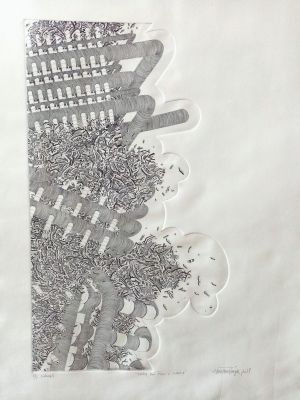
In an artwork called Psych, I tried to offer stereotypical views on how art is based on feelings, and science on reason, through a graphic sheets made in the technique of etching, to offer their views on Psyche or the soul touches the physical and the spiritual world and connects them. The psyche contains the emotions and thoughts of man through which he creates different images and thus has the role of mediator whose basic characteristic is dynamics. Inside it, the impulses of the spiritual and material world meet, so it is also called the crossroads. The transmission of spiritual impulses into a person's daily life will depend on the purity or passability of the psyche or soul. It is also called a mirror, because it reflects all the spiritual and instinctive movers of man. It can give a picture of the animal or divine nature of man, depending on what impulses he is associated with. At the same time, it symbolizes the human soul torn by feelings, thoughts and one's own notions of reality. The first to think about the relationship between art and reality were the ancient Greeks, and the term mimesis is justifiably at the root of both the philosophy of art and philosophy in general. Unlike art, for which an emotional approach to the world is important, science deals with the acquisition and arrangement of human knowledge, and for it a rational approach to reality is important. Art is a special form of cognition created by intuition, and intuition is the ability to predict, that is, comprehension that occurs before the process of thinking and intellectual (logical) cognition. Thus, intuition is cognition by means of imagination, and not by means of intellect which is commonly considered to be the creator of cognition. Furthermore, it is always known individually, and never in general. Intuition creates an image, while intellect creates a concept. It follows that art is also cognition by intuition, unlike science or philosophy in which cognition is realized by reason. In his Creative Denomination, Paul Klee compares art to the Creation of the world. He does not repeat the visible, but makes it visible, and the artist, like God back then, looks at what he has done - and thinks his own. At the beginning is the act, above the act comes the idea - Klee's titles come at the end, they are associations and dissociations, but they are by no means frameworks of answers to be filled with questions, but poetry that began with "an unexpected encounter between a sewing machine and an umbrella dissecting ... By choosing inaccessible places for refuge, he violated the rules of logic and stepped into the circulus vitiosus. "
Dati dell'opera
Altro - AltroDimensioni dell'opera - L 78 | A 107 |