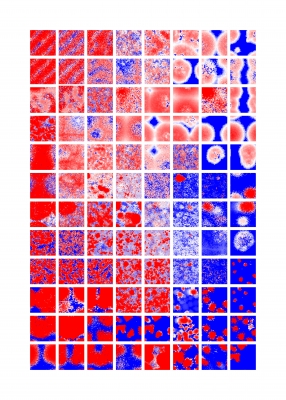
There are structures in nature that spontaneously emerge. They were studied for the first time by the English mathematician Alan Turing (1912 – 1954), who also introduced the concept of the contemporary computational machine. Examples of those shapes are stripes, spots, grids, tessellations, bubbles, spirals, foams and waves. In the specific case of this artwork, a collection of Turing patterns are generated via brain simulations. Each square is a network of neural cells that fire with low (blue), medium (white) and high (red) intensities. Many of them look very similar, while others are very different. Grouped as they are, pictures seem to have a graphical continuity with their closest. But, this visual feature is indeed a Gestalt illusion, because they are completely independent simulation results.
Подробная информация о произведении искусства
Цифровая графика - Компьютерная ГрафикаРазмер произведения - Ширина 59,4 | Высота 84,1 |
Создано 15 июнь 2021