
Soundweaving
1. My inspiration came from the punch cards in the weavers workshop that the weaving machines used. Early computers also used such punch cards, with the information coded in such formats. The weaving machinery too works on this basis, and I imagined, why not make pretty motifs on the punch cards. I thought back to my youth, seeing the music boxes in fairs and managed to connect the two concepts. I was earlier a member of a Hungarian folk dancing group, during which time I wore embroidered clothes. We performed often in villages, where I collected cross stitch patterns from pillowcases, tablecloths, shirts. Later on, I was able to transform these pattern onto the punch cards. Music has always been part of my life. I used to be a member of several choirs, I also played the flute, but instead I decided to apply for the University of Applied Arts. This time I worked with a musician and composer Bálint Tárkány-Kovács, who has helped my patterns become a string of sounds.
2. Composing and design are seemingly two very different processes, but in fact both creative processes include a base motif, a mirroring of the motif, vertical and horizontal mirroring of the vertical motif. We combined these processes during the composition phase. We were surprised to hear that the tulips and pomegranates actually make a pleasant sound, but this is not the complete picture. Our motif development used by Bálint for the melody creating also included selection, such that since the thick patters of tulips would make a dense sound, in the first part of the patterns only the tulips' stalks and leaves were used, and then after the whole tulip motif can be heard. In other cases, it was possible to temporally shift two of the same motifs, melodies from each other, creating a canonical sound.
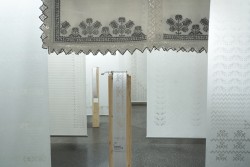
This layered approach can also be observed on the laser cut textiles. One pattern is created from two individual textile patters. The laser cutting technique refers back to the holes, the sounds of the punch cards.

Подробная информация о произведении искусства
Инсталация - ТекстильРазмер произведения - Ширина 90 | Высота 250 |
Создано 8 апрель 2013
